|
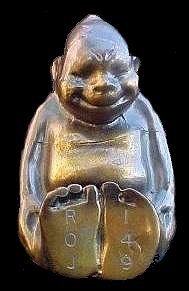
The second most popular theory credits the Alaskan Eskimos. The Eskimos began carving Billikens in ivory sometime between the turn of the Century and the year 1913, either at Nome, Alaska or Diomede Island. Dorothy Jean Ray's article in the Alaska Sportsman, published in September 1960, unraveled the mystery of the Billiken. In the article she related her accidental discovery of the Billikens origin. On a visit to Seattle's 'Ye Olde Curiosity Shop' she discovered a Billiken, not a carved ivory figurine, but a big gray cast iron coin bank. Almost illegible writing on the back turned out to be, Patent No. D-39603. An inquiry to the U.S. Patent Office revealed that in 1908 a young woman, Florence Pretz of Kansas City, Missouri was awarded a patent for a 'new design' for an image called "A Billiken". In 1909 the Billiken was manufactured as a coin bank and statuette, followed the next year by dolls. The 'American Doll and Toy' company made more than 200,000 dolls which were the rage for 6 months and then disappeared. Though The Royal Order of Jesters adopted the Billiken as an ambassador of 'Good Luck', in the U.S. Patent Office is the proof that the Billikens origin preceded the formation of the ROJ. |